Few tech stocks attract as much attention from retail and institutional investors as Apple Inc. When analysts and market watchers examine the stock price Apple computer trajectory heading into 2026, the conversation quickly becomes layered with competing data points, product cycle speculation, and macroeconomic variables. Apple's market capitalization hit $2.5 trillion in early 2026, a figure that speaks to the company's enduring grip on consumer electronics and enterprise software. Yet past performance never guarantees future results, and the range of forecasts currently circulating — projecting share prices between $200 and $250 — reflects genuine uncertainty among even the most seasoned analysts. Understanding what sits behind those numbers, and how to position around them, matters whether you hold a handful of shares or manage a diversified portfolio.
Current Trends Shaping Apple's Stock Performance
Apple's NASDAQ-listed shares have navigated a turbulent stretch over the past two years, swinging on everything from Federal Reserve rate decisions to supply chain disruptions out of Southeast Asia. Despite that volatility, the stock has maintained a broadly upward bias, supported by consistent earnings per share (EPS) growth that has outpaced many large-cap technology peers. EPS measures a company's profit divided by its outstanding shares, and Apple's ability to keep that figure climbing — even as revenue growth has moderated — signals disciplined cost management rather than simple top-line expansion.
Trading volume on heavy news days routinely exceeds 80 million shares, a liquidity profile that attracts both algorithmic traders and long-term institutional holders. That depth makes Apple one of the few stocks where large block trades rarely cause outsized price dislocations. The stock's price-to-earnings ratio has hovered in a range that many growth-oriented analysts consider stretched, yet the premium persists because investors assign significant value to Apple's recurring services revenue, which now accounts for roughly a quarter of total company revenue.
The S&P 500's heavy weighting toward Apple means that broad index moves often amplify or dampen Apple-specific news. When the index sold off sharply in late 2022 and again in parts of 2023, Apple fell with it despite solid underlying fundamentals. Heading into 2026, that correlation cuts both ways: a broader market rally lifts Apple even on quiet product news days, while a risk-off environment can punish the stock regardless of quarterly results. Investors who treat Apple purely as a tech play sometimes miss this macro sensitivity.
Short interest in Apple remains relatively low by historical standards, which limits the potential for dramatic short-squeeze rallies but also reduces downside pressure from forced covering. Options market activity around earnings dates has grown substantially, with implied volatility often pricing in moves of 4–6% in either direction on results day. That options premium represents real cost for hedgers and real opportunity for income-focused investors selling covered calls against existing positions.
What Actually Moves the Stock Price of an Apple Computer Giant
Apple's share price responds to a distinct set of drivers that differ meaningfully from other technology companies. Identifying those drivers with precision helps investors separate signal from noise in the constant flow of analyst commentary.
- iPhone upgrade cycles: The iPhone still generates over half of Apple's total revenue. Any shift in consumer willingness to upgrade — whether driven by pricing, feature differentiation, or carrier subsidy structures — registers quickly in earnings estimates and, by extension, in the share price.
- Services revenue growth: The App Store, Apple Music, iCloud, and Apple TV+ collectively form a high-margin business that analysts value separately from hardware. Sustained double-digit growth in this segment commands a premium multiple.
- AI integration pace: The tech sector in 2026 is heavily defined by artificial intelligence deployment. Apple's ability to embed AI features convincingly into its devices — without compromising its privacy positioning — determines whether it gains or loses ground against Android competitors.
- Regulatory exposure: Antitrust scrutiny of the App Store in the United States and Europe introduces headline risk that can create sharp intraday moves, even when the underlying legal outcomes remain years away.
- Share buyback program: Apple has returned hundreds of billions of dollars to shareholders through repurchases. The ongoing buyback mechanically supports EPS by reducing the share count, and any reduction in that program would likely trigger a negative market reaction.
Currency fluctuations add another layer of complexity. Apple generates roughly 60% of its revenue outside the United States, so a strengthening dollar directly compresses reported international earnings. This dynamic played out visibly in 2022, when dollar strength shaved meaningful dollars off reported quarterly results despite solid unit volumes in Europe and Asia.
What Financial Analysts Are Forecasting
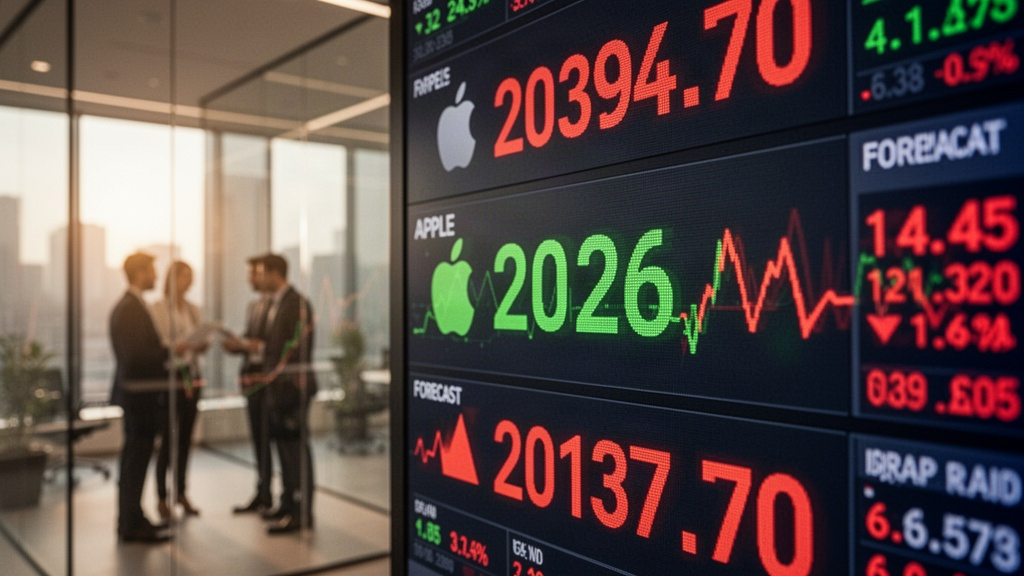
The consensus view among Wall Street analysts tracked by platforms like Yahoo Finance and MarketWatch places Apple's 12-month price target in the $220–$250 range as of early 2026. That spread reflects different assumptions about iPhone 17 cycle strength, the pace of Vision Pro adoption, and the contribution of Apple Intelligence features to upgrade demand. A minority of bearish analysts cite valuation concerns, arguing that the current multiple already prices in an optimistic scenario for services growth.
Price targets from investment firms are not predictions — they are models. Each model bakes in assumptions about revenue growth, margin trajectory, and an appropriate discount rate. Change the discount rate by 50 basis points and a $240 target becomes $215. That mechanical sensitivity explains why analyst targets cluster and then shift together when the Federal Reserve signals a rate change, even before Apple reports a single new number.
Historically, Apple has beaten consensus EPS estimates in the majority of its reported quarters over the past decade. That track record encourages analysts to embed a degree of conservatism in their models, knowing management tends to guide cautiously. The result is a pattern where "beats" are common but rarely produce dramatic stock reactions because the market has already partially priced in outperformance. Guidance language — the qualitative commentary management provides about the coming quarter — often moves the stock more than the reported numbers themselves.
Some independent analysts have flagged China market risk as the variable most likely to produce a downside surprise. Apple's exposure to Chinese manufacturing and Chinese consumer demand creates a dual vulnerability: production disruption risk and revenue risk from rising domestic competition by brands like Huawei. A meaningful deterioration in either dimension could push the stock toward the lower end of the $200–$250 forecast range.
Practical Approaches for Investors Watching Apple Shares
Owning Apple shares is not a monolithic strategy. The way an investor structures their position depends heavily on time horizon, tax situation, and appetite for volatility. Long-term holders who have owned Apple since the early 2010s face a very different decision set than someone considering a new position at current valuations.
Dollar-cost averaging — buying a fixed dollar amount of Apple shares at regular intervals regardless of price — removes the psychological burden of timing the market. For investors who believe in Apple's long-term trajectory but find the current valuation uncomfortable, this approach spreads entry risk across multiple price points. Brokerage platforms now make fractional share purchases straightforward, so even investors without the capital for a full share can participate in this strategy.
Covered call writing appeals to investors who already hold a substantial Apple position and want to generate income while the stock trades sideways. By selling call options at a strike price above the current market price, the holder collects premium upfront. The trade-off: if Apple surges past the strike, the shares get called away and the investor misses that upside. In a range-bound environment, the income from repeated call sales can meaningfully enhance total return. Tax treatment of options income varies by jurisdiction and holding period, so consulting a qualified tax advisor before implementing this strategy is straightforward prudence.
Portfolio concentration deserves attention. Apple's weighting in many passive index funds is substantial, meaning that investors holding broad ETFs alongside individual Apple shares may have more single-stock exposure than they realize. Running a portfolio analysis to quantify total Apple exposure — across all holdings — gives a clearer picture of actual risk.
Reading the 2026 Forecast Range With Realistic Expectations
The $200–$250 forecast range for Apple's share price is wide enough to accommodate both a modest disappointment and a genuine upside surprise. That width is not a failure of analysis — it reflects honest uncertainty in a market where a single product announcement, a regulatory ruling, or a shift in Federal Reserve policy can reprice the stock by 10% in a week.
Apple's $2.5 trillion market capitalization means it takes an enormous amount of new capital to push the stock materially higher from current levels. The law of large numbers applies: percentage gains that were achievable when Apple was a $500 billion company require proportionally more absolute dollar inflows today. Institutional ownership exceeds 60% of the float, so the marginal buyer is increasingly another large fund rather than a new retail participant discovering the stock for the first time.
What the forecast range does confirm is that the analyst community sees no fundamental reason for a dramatic de-rating of Apple's multiple in the near term. The services business provides earnings visibility that hardware-only companies cannot match. Free cash flow generation remains among the strongest of any publicly traded company globally, and that cash provides management with flexibility to invest, acquire, or return capital depending on what the competitive environment demands. Investors who anchor to the $200 floor of the forecast range as a rough margin of safety may find it a more durable reference point than the optimistic upper end — not because the upside is impossible, but because disciplined investing starts with protecting the downside.