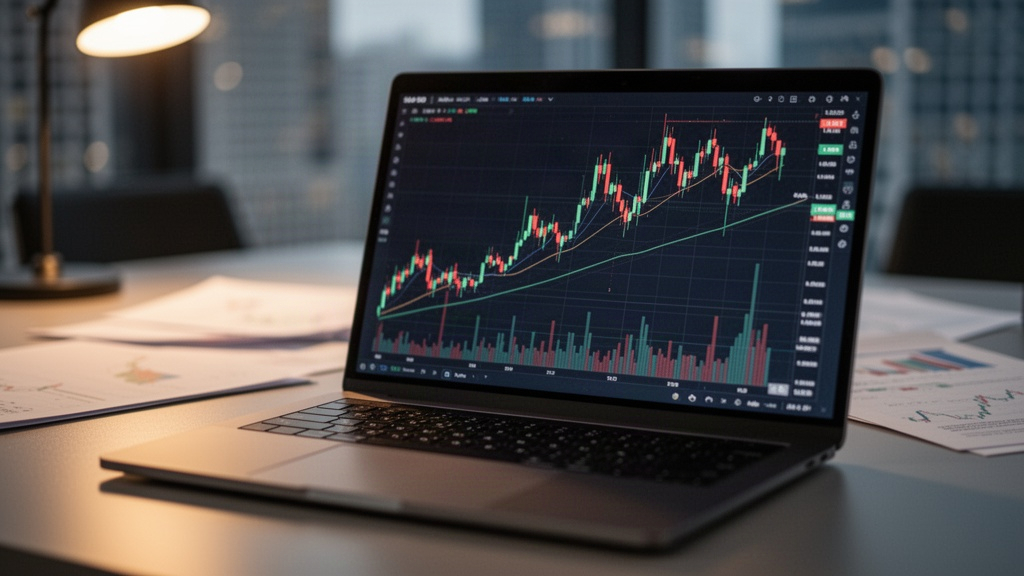
The S&P 500 is one of the most closely watched financial benchmarks in the world, and for good reason. Tracking the performance of 500 large-cap U.S. companies, it gives investors a real-time pulse on the health of the American economy. Whether you are building a retirement portfolio, managing a business's cash reserves, or simply trying to grow personal wealth, understanding how the sandp500 moves can sharpen every investment decision you make. This index is not just a number scrolling across a screen — it is a structured signal that, when read correctly, tells you where capital is flowing, which sectors are gaining momentum, and how risk appetite is shifting across the market. The following sections break down exactly how to put that signal to work.
Understanding the S&P 500 and Its Role in Financial Markets
The S&P 500 was created and is maintained by Standard & Poor's, a division of S&P Global. It tracks 500 publicly traded U.S. companies selected based on market capitalization, liquidity, and sector representation. The index is market-cap weighted, meaning larger companies like Apple, Microsoft, and Amazon carry more influence over the index's daily movement than smaller constituents.
This weighting structure matters for investors. When the index rises 1%, it does not mean all 500 companies gained equally. A handful of mega-cap stocks can drive the entire index upward while the majority of constituents remain flat or decline. Understanding this dynamic prevents a common mistake: assuming broad market strength when only a narrow group of stocks is actually performing.
Historically, the S&P 500 has delivered an average annual return of 10 to 11% over the long term, making it one of the strongest benchmarks for passive wealth accumulation. That figure accounts for multiple recessions, market crashes, and geopolitical crises. It does not, however, account for inflation, taxes, or fees — costs that erode real returns and must be factored into any honest performance assessment.
The index is also a regulated financial instrument under the oversight of the SEC (Securities and Exchange Commission), which enforces disclosure standards for every company listed within it. This regulatory layer gives institutional and retail investors a degree of transparency that less regulated markets cannot offer. For business owners and corporate treasurers allocating surplus capital, that transparency is a genuine advantage when comparing the S&P 500 against alternative asset classes.
Beyond returns, the index functions as a reference point for benchmarking. Fund managers, pension administrators, and individual brokers all measure their performance against it. Beating the S&P 500 consistently is difficult — which is precisely why many professional investors choose to track it rather than attempt to outperform it.
How to Read S&P 500 Trends Before Making a Move
Reading the S&P 500 effectively requires more than watching its daily price. Trend analysis involves layering multiple signals to build a coherent picture of market direction. Here is a practical sequence that experienced investors follow:
- Track the 200-day moving average: When the index trades above this line, the long-term trend is bullish. When it falls below, caution is warranted.
- Monitor sector rotation: The S&P 500 is divided into 11 sectors. Money shifting from defensive sectors (utilities, healthcare) into cyclical ones (technology, consumer discretionary) signals growing investor confidence.
- Watch the VIX index: Known as the "fear gauge," a rising VIX alongside a falling S&P 500 often signals panic selling rather than fundamental deterioration.
- Analyze earnings season data: Corporate earnings reports from S&P 500 constituents, released quarterly, reveal whether the index's price levels are supported by actual business performance.
Beyond these technical signals, macroeconomic data directly shapes S&P 500 behavior. Federal Reserve interest rate decisions, inflation readings from the Bureau of Labor Statistics, and employment figures from the Bureau of Labor Statistics all move the index. When the Fed raises rates aggressively, borrowing costs increase for S&P 500 companies, compressing profit margins and often triggering a repricing of equities.
One underused analytical tool is breadth analysis. Rather than watching the index price alone, breadth measures how many constituent stocks are advancing versus declining. A rising index with weak breadth — where only a small number of stocks are driving gains — is a fragile rally. Broad participation across hundreds of constituents signals more durable upward momentum.
Platforms like Yahoo Finance and S&P Global's own data portal provide free access to historical index data, sector breakdowns, and constituent performance. Cross-referencing these sources regularly builds a clearer picture than relying on any single data point.
Practical Investment Strategies Built Around the S&P 500
The most straightforward strategy is index fund investing. By purchasing an S&P 500 index fund or ETF — such as those offered by Vanguard, BlackRock's iShares, or State Street's SPDR — investors gain proportional exposure to all 500 companies at a fraction of the cost of buying individual stocks. Expense ratios on major S&P 500 ETFs often fall below 0.05%, making them among the most cost-efficient investment vehicles available.
Dollar-cost averaging pairs naturally with this approach. Rather than investing a lump sum at a potentially unfavorable moment, investors commit a fixed dollar amount at regular intervals — monthly or quarterly. Over time, this strategy automatically purchases more shares when prices are low and fewer when prices are high, reducing the impact of short-term volatility on the overall cost basis.
For business owners with longer time horizons, the S&P 500 can serve as a core holding within a diversified portfolio. Surrounding it with international equities, fixed income, and alternative assets reduces concentration risk while still capturing the long-term growth the index has historically delivered. The specific allocation depends on the investor's time horizon, liquidity needs, and risk tolerance — not on short-term market noise.
A more active strategy involves tactical allocation shifts based on S&P 500 signals. When the index shows sustained weakness alongside deteriorating breadth and rising volatility, reducing equity exposure and increasing cash or bond allocations can protect capital. This is not market timing in the speculative sense — it is a disciplined, rules-based response to measurable market conditions. The distinction matters because purely emotional reactions to short-term drops are the primary driver of poor investor outcomes.
Dividend reinvestment is another angle worth considering. Many S&P 500 companies pay regular dividends, and automatically reinvesting those payments compounds returns over time. Over a 20-year period, reinvested dividends have historically accounted for a significant portion of the index's total return, a fact that purely price-focused investors often overlook.
Risks Every Investor Must Weigh Before Committing Capital
The S&P 500's long-term track record is strong, but it does not eliminate risk. Sequence of returns risk is particularly relevant for investors approaching retirement. A sharp market decline in the early years of withdrawal — even if the market recovers later — can permanently impair a portfolio because capital is being drawn down at depressed prices before recovery occurs.
Concentration risk within the index itself deserves attention. As of recent years, the top ten holdings in the S&P 500 account for roughly 30% of the entire index's weight. This means investors who believe they are broadly diversified are actually quite exposed to the performance of a small cluster of technology and consumer companies. Recognizing this concentration helps investors decide whether supplemental diversification is necessary.
Currency risk affects international investors holding U.S.-denominated S&P 500 assets. A strengthening dollar benefits returns when converted back to a foreign currency, but a weakening dollar erodes them. Hedged ETF products exist specifically to neutralize this exposure for non-U.S. investors.
Regulatory changes also carry weight. The SEC periodically updates disclosure requirements, and shifts in corporate tax policy directly affect the earnings of S&P 500 constituents. In 2026, ongoing debates around capital gains taxation and corporate minimum tax rates in the U.S. continue to influence how institutional investors position themselves relative to the index.
Past performance, as any reputable financial source will confirm, does not guarantee future results. The S&P 500 has delivered exceptional long-term returns, but it has also experienced peak-to-trough declines exceeding 50% during periods like the 2008 financial crisis. Investors who could not tolerate those drawdowns and sold at the bottom locked in losses that patient investors recovered from. Knowing your own risk capacity before entering any position is the most practical risk management tool available.