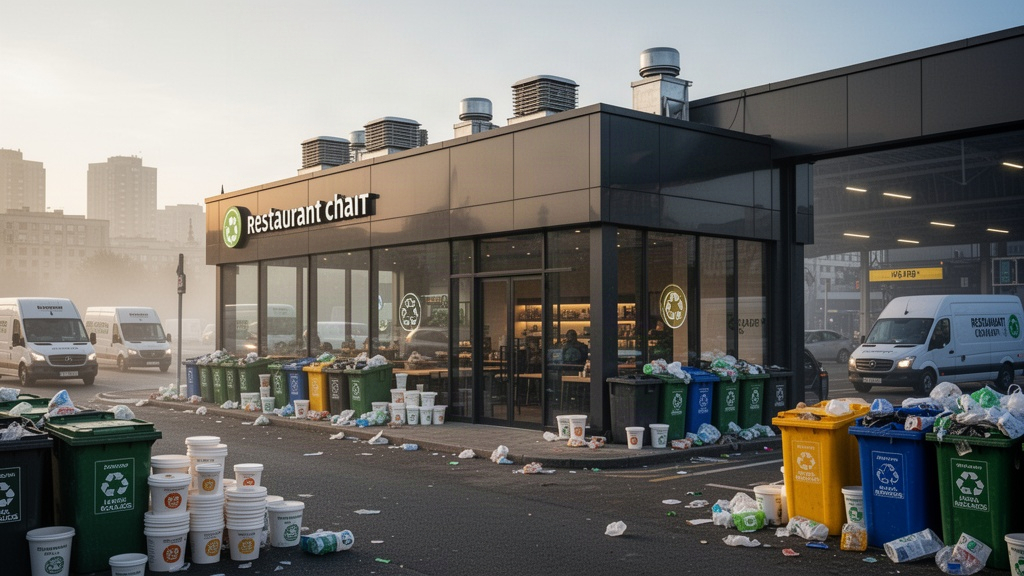
The environmental record of the restaurant chain sector has never faced more scrutiny. Regulators, investors and consumers are demanding answers that go well beyond recyclable packaging and energy-saving lightbulbs. A single outlet can manage its waste informally. A network operating thousands of locations across multiple countries operates at a scale where every procurement decision, every kilowatt consumed and every tonne of food discarded becomes a systemic issue. The global food system accounts for roughly 26% of worldwide greenhouse gas emissions, according to a widely cited 2021 estimate, and large foodservice operators sit squarely within that figure. Understanding where the damage actually occurs — and whether corporate pledges are closing the gap — requires looking at the numbers honestly.
Why a restaurant chain has a larger footprint than a single outlet
Scale changes everything. A neighbourhood diner sources ingredients locally, burns gas in one kitchen and throws away a manageable amount of food each week. A restaurant chain operating five thousand locations replicates those impacts five thousand times over, then adds the emissions embedded in a centralised supply network, a cold logistics infrastructure and standardised packaging produced by the millions. The multiplication effect is not linear: centralised buying can reduce per-unit costs but also locks the business into commodity supply chains with their own land-use and water footprints.
Under the GHG Protocol framework, chain operators must account for three emission scopes. Scope 1 covers direct combustion in kitchens and owned vehicles. Scope 2 covers purchased electricity. Scope 3 — the category that typically represents 70 to 90% of a food business's total footprint — covers everything upstream and downstream: agricultural production, ingredient processing, packaging manufacture, franchisee operations, customer waste and food sent to landfill. Most public commitments from large operators focus heavily on Scope 1 and 2 because the data is easier to control. Scope 3 is where the real volume sits.
Water consumption adds another dimension. A single burger patty requires several hundred litres of water across its agricultural lifecycle. Multiply that by millions of servings per day across a major brand, and water stress in beef-producing regions becomes a direct corporate liability. Energy intensity is similarly amplified: cooking equipment, refrigeration, HVAC and lighting running continuously across thousands of sites generate electricity demand that no single outlet could approach. The franchise model further complicates accountability, because franchisee operators may use different equipment, utilities and waste contractors, making consolidated reporting genuinely difficult.
Read also: How to leverage customer feedback for your restaurant chain
The environmental hotspots across the restaurant value chain
Ingredients dominate the carbon story. Ruminant proteins — beef and lamb in particular — carry a substantially higher greenhouse gas footprint per kilogram than most plant-based alternatives, when the full lifecycle is assessed: feed production, methane from enteric fermentation, land-use change and processing. A menu built around burgers and beef-based dishes will carry a structurally higher Scope 3 burden than one centred on chicken, fish or legumes, regardless of how efficiently the restaurants themselves are run.
Food waste is the second major hotspot. The FAO estimates that roughly one third of all food produced globally is lost or wasted across the entire supply chain. In the UK, WRAP estimates that the hospitality and food service sector generates over one million tonnes of food waste annually. In the US, the Environmental Protection Agency identifies food as approximately 24% of what ends up in landfill, where it generates methane as it decomposes. For a large chain, overproduction driven by demand forecasting errors, plate waste and spoilage in the supply chain each contribute to that figure.
Packaging is a third pressure point. Single-use plastics, composite materials and non-recyclable wrappers have attracted regulatory attention in both the US and the UK, with bans and extended producer responsibility schemes tightening requirements. Cold chain logistics — the refrigerated transport linking distribution centres to individual restaurants — adds both energy consumption and refrigerant leakage risk, since many industrial refrigerants carry high global warming potential. These hotspots interact: a chain that reduces food waste also reduces the embedded emissions in the ingredients that were never eaten.
Restaurant chain sustainability claims under scrutiny
Large operators have published increasingly detailed ESG reports over the past several years. McDonald's, Yum! Brands, Restaurant Brands International, Starbucks and Chipotle Mexican Grill have all announced emissions reduction targets, with several referencing alignment with the Science Based Targets initiative. The ambition on paper is real. The gap between stated goals and verified outcomes is where independent analysis becomes necessary.
Read also: Why you shouldn't overlook what is financial education for growth
Several structural problems recur. First, many published targets exclude a significant portion of franchised locations, or apply only to company-owned restaurants. A brand that franchises 90% of its network can report impressive Scope 1 and 2 reductions while the vast majority of its physical footprint operates outside the boundary of the commitment. Second, carbon offsets are frequently used to claim neutrality without corresponding absolute reductions in emissions. The CDP and the Science Based Targets initiative both require companies to demonstrate genuine reductions rather than relying primarily on offset purchases, but not all chains meet that standard. Third, data comparability across brands remains limited: different base years, different Scope 3 inclusion boundaries and different methodologies make direct comparisons unreliable without careful verification.
The risk of greenwashing is not theoretical. Regulatory bodies in the UK and US have begun scrutinising environmental claims more aggressively, and the IFRS Foundation's ISSB sustainability standards are raising the bar for what constitutes a credible disclosure. Chains that use terms like "sustainable", "eco-friendly" or "carbon neutral" without clear, audited definitions are increasingly exposed to legal and reputational challenge.
What major brands are changing — and what remains unresolved
| Lever | Primary impacts addressed | Indicators to examine | Limits and communication risks |
|---|---|---|---|
| Ingredient sourcing | Scope 3 emissions, land use, water consumption | % of beef from verified sustainable sources, deforestation commitments | Certification standards vary; supplier audits are often incomplete |
| Energy efficiency | Scope 1 and 2 emissions, operating costs | kWh per restaurant, % renewable electricity purchased | Franchisee sites may be excluded; renewable energy certificates do not always reflect physical supply |
| Food waste reduction | Landfill methane, embedded agricultural emissions | Kg of waste per cover, diversion rate from landfill | Measurement methodologies differ; donations and animal feed diversion inflate diversion figures |
| Packaging redesign | Plastic pollution, material resource use | % recyclable or compostable packaging, single-use plastic weight | Recyclability depends on local infrastructure; "compostable" labels can mislead consumers without industrial facilities |
| Supply chain transport | Scope 3 logistics emissions, air quality | Fleet electrification rate, tonne-km emissions intensity | Third-party logistics providers may not share data; electric vehicle charging infrastructure varies by region |
Some changes are genuine. Several major chains have introduced lower-carbon menu options, including plant-based proteins and reduced-portion beef items, and have measured the resulting shift in average meal emissions. Starbucks has published water stewardship data tied to specific agricultural regions. Chipotle has invested in local sourcing programmes that reduce transport distances for certain ingredients. These are not trivial initiatives when applied at scale.
What remains structurally unresolved is the business model tension. A chain's revenue depends on volume: more transactions, larger portions, higher frequency of visits. Absolute emissions reductions require either a shrinking menu carbon intensity or a shrinking business. Very few operators have acknowledged that tension openly, and none of the major brands has committed to absolute Scope 3 reductions that are independent of revenue growth. Intensity-based targets — cutting emissions per meal rather than in total — allow total emissions to rise if the business expands, which is the direction most chains are pursuing.
Read also: Essential Steps on How to Invest in Stocks for Beginners
How to judge whether progress is credible
Four tests separate credible progress from well-packaged ambiguity. The first is boundary completeness: does the reported data cover franchised locations, or only company-owned restaurants? A commitment that excludes the majority of physical locations is not a meaningful system-level commitment. Ask for the percentage of total network covered by every reported metric.
The second test is absolute versus intensity. Emissions per meal can fall while total emissions rise. Any brand claiming leadership should be able to show absolute Scope 1, 2 and 3 reductions against a fixed base year, not just improvements in efficiency ratios. The Science Based Targets initiative requires absolute reductions for Scope 1 and 2; Scope 3 targets are more complex but should still reflect genuine supply chain transformation.
The third test is independent verification. Self-reported sustainability data carries limited weight without third-party assurance. Look for audit statements from recognised assurance providers, and check whether the assurance covers all three scopes or only the easier-to-measure direct emissions. The CDP disclosure platform provides a useful cross-reference, though it relies on company-submitted data.
The fourth test is interim milestones. A net-zero target for 2050 with no binding intermediate steps is a statement of intent, not a plan. Credible commitments include verified progress markers for 2028, 2030 and 2035, with consequences — governance, capital allocation or executive remuneration — attached to missing them. Chains that publish only long-dated targets without near-term accountability structures are signalling that the commitment is reputational rather than operational. That distinction matters for anyone trying to assess whether the industry's environmental trajectory is actually changing.