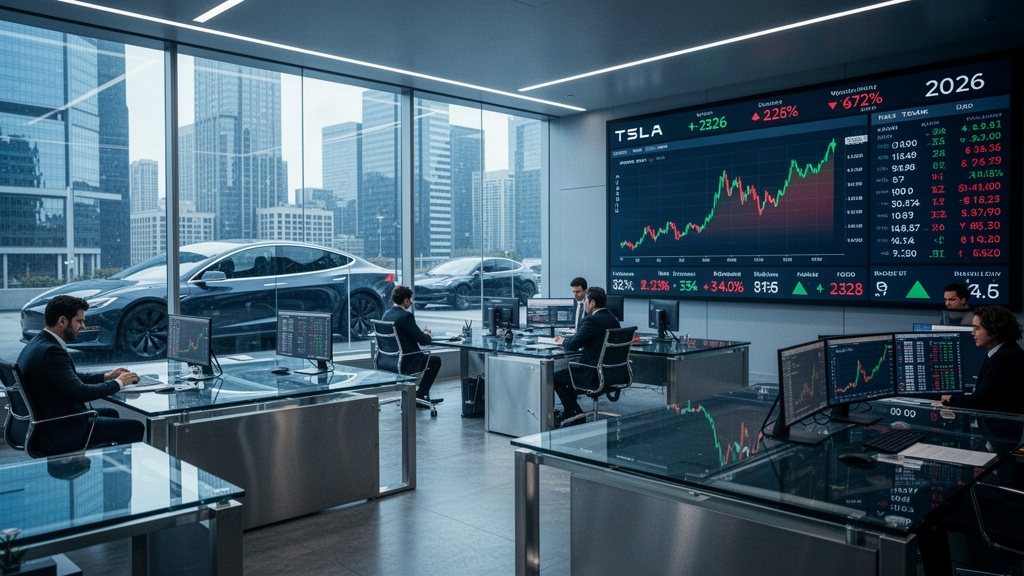
Nasdaq: TSLA is one of the most watched tickers on any trading screen in 2026. Tesla, Inc. has long defied conventional automotive valuation logic, trading less like a car company and more like a technology platform with wheels attached. That distinction matters enormously for anyone trying to understand why the stock commands such attention from institutional investors, retail traders, and financial analysts alike. The company's reach now extends well beyond vehicle manufacturing, touching energy storage, artificial intelligence, and autonomous driving software. Whether you are building a long-term position or simply tracking market signals, understanding what drives TSLA requires looking at multiple layers simultaneously — financial performance, competitive positioning, regulatory exposure, and the gap between what the market expects and what Tesla actually delivers.
Why Nasdaq: TSLA Still Captures Investor Attention
Tesla occupies a category of its own on the Nasdaq Stock Market. Few companies simultaneously operate in electric vehicles, grid-scale battery storage, and artificial intelligence-driven software, and fewer still generate the trading volumes that TSLA regularly produces. That breadth of activity is precisely what keeps institutional investors and retail traders returning to the ticker, regardless of short-term price swings.
The company's brand recognition translates directly into demand signals that competitors struggle to replicate. While BYD, General Motors, Ford, and Volkswagen have all accelerated their EV programs, none of them carries the same software-first narrative that Tesla has built over more than a decade. That narrative supports a valuation premium that pure automotive metrics alone cannot justify.
Tesla's inclusion in major indices amplifies its market footprint. Passive funds tracking the S&P 500 and Nasdaq-100 must hold TSLA in proportion to its weighting, creating structural buying pressure that exists independently of any fundamental view. This mechanical demand partly explains why the stock can remain elevated even during periods of earnings pressure.
Investor sentiment around TSLA also reflects broader macro themes. Rising interest in autonomous vehicle regulation, federal clean energy incentives under U.S. environmental policy, and the global push toward electrification all feed into the stock's narrative. When any of these themes accelerate, TSLA tends to benefit disproportionately compared to legacy automakers, simply because the market has already assigned Tesla a technology multiple rather than an industrial one.
Financial and Operational Indicators Worth Tracking
Analyzing TSLA without anchoring the discussion in actual financial data is a common mistake. The company publishes quarterly earnings, annual 10-K filings with the U.S. Securities and Exchange Commission, and detailed delivery reports that provide the raw material for any serious assessment.
Read also: Exploring the SP 500: A Must-Read for Business Investors
Vehicle deliveries remain the most closely watched operational metric. Tesla reports deliveries quarterly, and the figures consistently move the stock in the days surrounding their release. It is worth noting that deliveries and recognized revenue are not identical — timing differences and product mix both affect the translation from units delivered to dollars earned.
Operating margin has been a pressure point in recent periods. Aggressive price cuts across Tesla's lineup, introduced to defend market share against intensifying competition, compressed margins significantly from their 2022 peak levels. Investors tracking TSLA in 2026 should consult the most recent 10-Q or earnings release to assess whether margin recovery is materializing or whether pricing pressure continues.
The energy generation and storage segment deserves particular attention. Megapack deployments and Powerwall installations have grown substantially, and this segment carries different margin characteristics than vehicle sales. A company that can grow high-margin energy revenue alongside its automotive business has a more defensible financial profile than one relying solely on vehicle pricing cycles.
Free cash flow generation and the balance sheet position round out the picture. Tesla has historically maintained a relatively strong cash position, which provides flexibility for capital expenditure on new factories, research, and product development without requiring constant external financing.
Growth Levers That Could Support the Valuation
Several forward-looking factors explain why analysts and investors assign Tesla a valuation that exceeds conventional automotive peers. These are objectives and scenarios, not guaranteed outcomes, and the Tesla Investor Relations team consistently frames them as prospective targets subject to technological, regulatory, and commercial conditions.
Full Self-Driving software remains the most debated growth lever. If Tesla achieves regulatory approval for unsupervised autonomous operation at scale — a process overseen in the U.S. by the National Highway Traffic Safety Administration — the software licensing and robotaxi service revenue potential would be transformative. The gap between current FSD capabilities and that threshold is real and should not be glossed over.
Read also: The Pros and Cons of Investing in Palantir Stocks
The Optimus humanoid robot program represents a longer-horizon bet. Tesla has demonstrated prototype units and communicated production ambitions, but commercial deployment at meaningful scale remains a forward objective for 2026 and beyond. The addressable market for industrial and domestic robotics is genuinely large, which explains why the market incorporates some probability-weighted value for this program even before revenue materializes.
New vehicle models, including more affordable variants designed to expand the addressable consumer base, could accelerate delivery volumes. Lower price points carry margin trade-offs, but higher unit volumes improve manufacturing efficiency and software monetization opportunities across a larger installed base.
Risks That Investors Cannot Afford to Ignore
A balanced view of TSLA requires confronting the risks that could weigh on the stock. Competition intensity has increased materially. BYD now delivers more vehicles globally than Tesla in certain periods, and established manufacturers from Volkswagen to Hyundai are fielding competitive EV lineups with improving software integration.
Pricing pressure directly affects operating margins. When Tesla reduces vehicle prices to stimulate demand, the benefit in volume terms can be offset by the hit to per-unit profitability. Investors should track whether price stabilization or recovery is occurring in the most recent quarters before drawing conclusions about margin trajectory.
Regulatory exposure spans multiple dimensions. The EPA and NHTSA both have authority over Tesla's products, and any adverse ruling on autonomous driving features, emissions compliance, or vehicle safety could affect both operations and investor confidence. SEC filings from Tesla explicitly list regulatory risk as a material factor affecting the business.
Governance and concentration risk around Elon Musk's leadership is a factor that institutional investors increasingly flag. His simultaneous involvement in multiple ventures creates attention and resource allocation questions that do not apply to more conventionally governed corporations.
Read also: What makes aerospace companies so vital for defense sectors
Supply chain dependencies on lithium, cobalt, and semiconductor components also introduce vulnerability to commodity price cycles and geopolitical disruptions that Tesla cannot fully control through vertical integration alone.
Reading TSLA Beyond the Daily Price Movement
The stock price of TSLA on any given day reflects a blend of sentiment, momentum, and fundamental expectation that can be difficult to disentangle. A more structured approach compares the implied valuation embedded in the current price against the realistic range of business outcomes.
The table below offers a snapshot comparison of Tesla against selected peers. All figures should be verified against the most recent official reports before any investment decision, as market data fluctuates continuously.
| Company | Segment Focus | Operating Margin (approx.) | Energy Storage Activity | Key Risk Factors |
|---|---|---|---|---|
| Tesla (TSLA) | EVs, Energy, AI/Software | Verify latest 10-Q | Megapack, Powerwall — growing | Margin pressure, competition, governance |
| BYD | EVs, Batteries | Verify latest filing | Battery manufacturing — integrated | Geopolitical exposure, export restrictions |
| General Motors | ICE + EV transition | Verify latest 10-Q | Limited | EV ramp costs, legacy pension obligations |
| Rivian | EV trucks and vans | Negative (growth phase) | None at scale | Cash burn, production scaling, competition |
| Volkswagen Group | ICE + EV (multi-brand) | Verify latest filing | Limited | EV software delays, European demand softness |
What this comparison illustrates is that Tesla's valuation premium over traditional automakers reflects its software ambitions and energy business, not just vehicle sales volumes. The premium is only justified if those adjacent businesses deliver at scale.
Analysts who follow TSLA through platforms tied to SEC EDGAR filings and Tesla's own investor relations portal tend to focus on the ratio between what is already priced into the stock and what remains genuinely uncertain. A high price-to-earnings ratio signals that the market has already incorporated significant future growth — which means the stock is more sensitive to disappointment than a lower-multiple peer would be.
Volatility is a defining characteristic of TSLA, not an anomaly. Traders and long-term holders experience the same underlying asset very differently. Understanding which category applies to your own situation is the first step toward using Tesla's market presence productively rather than reactively. This analysis is informational and does not constitute personalized investment advice — always consult a qualified financial professional before making investment decisions.