Urban farming is no longer a niche pursuit for rooftop enthusiasts or community garden volunteers. Businesses across sectors are treating it as a genuine strategic asset, and the reasons go well beyond corporate optics. With 68% of the world's population projected to live in urban areas by 2050, according to the UN Department of Economic and Social Affairs, the distance between food production and food consumption has become a real operational problem — and a commercial opportunity. Companies that recognize this early are positioning themselves ahead of supply chain pressures, shifting consumer expectations, and tightening sustainability requirements. The question is no longer whether urban farming belongs in a business conversation. It is how to integrate it in a way that generates measurable returns.
Why urban farming is becoming a strategic business opportunity
The structural case for urban food production has been building for years. Urbanization concentrates both consumers and commercial buyers in dense geographies, while conventional agricultural supply chains stretch across thousands of miles. That distance introduces cost, spoilage risk, and vulnerability to disruption — factors that became impossible to ignore after the supply shocks of the early 2020s.
Demand for locally sourced produce has shifted from a premium preference to a purchasing standard in many markets. Retailers, restaurant groups, and food service operators are actively seeking suppliers who can guarantee origin, freshness, and traceability. An urban producer operating within city limits can deliver leafy greens, herbs, or microgreens within hours of harvest. That is a logistical advantage that no distant supplier can replicate.
Institutional recognition has followed market demand. The USDA established its Office of Urban Agriculture and Innovative Production in 2020, signaling that urban food systems are a formal policy priority in the United States. The Food and Agriculture Organization has similarly integrated urban agriculture into its food security frameworks at the international level. These are not symbolic gestures — they indicate that funding, research, and regulatory frameworks are being built around this sector.
Businesses also face growing pressure to demonstrate supply chain resilience. Boards, investors, and procurement teams are scrutinizing dependency on long-haul logistics. An urban growing operation, whether owned or partnered, offers a degree of insulation from external shocks. It also creates a visible, verifiable local connection that matters to buyers and end consumers alike.
The opportunity is real, but it is not automatic. Companies that treat urban farming as a branding exercise without examining the underlying economics tend to underperform. Those that build it into their operational logic — with clear output targets, defined buyers, and realistic cost structures — are the ones generating durable value.
Read also: What are the bonds that can protect you during market downturns
The business benefits beyond food production
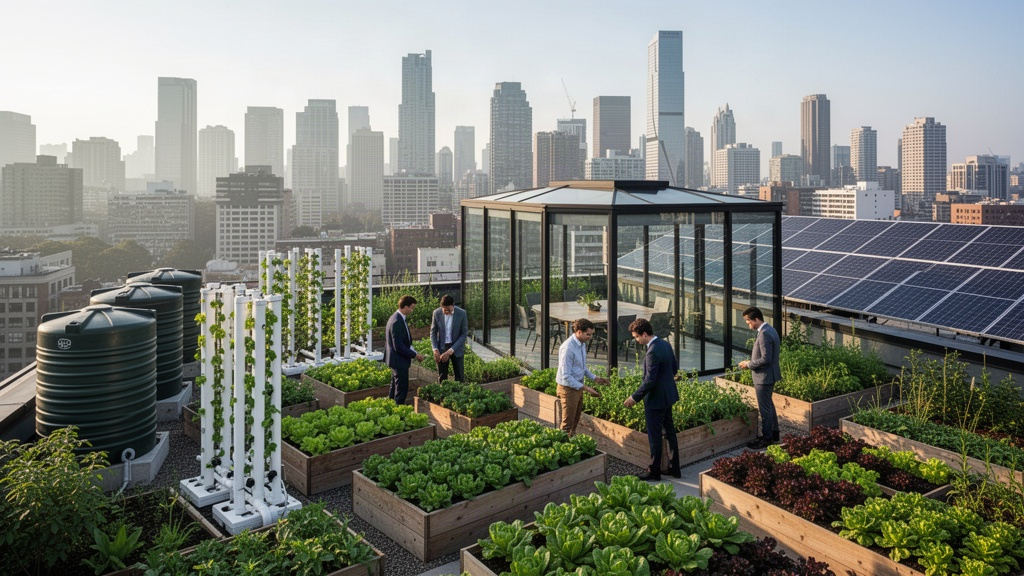
For many companies, the direct value of growing food is secondary to the indirect benefits that an urban farming operation unlocks. Brand differentiation is the most visible of these. A hotel group that sources herbs from a rooftop garden, a corporate campus that supplies its cafeteria from an on-site vertical farm, or a retailer that stocks produce grown in the same postcode as its stores — each of these creates a story that competitors cannot easily copy.
The ESG dimension is equally significant. Environmental, social, and governance reporting now affects access to capital, supplier relationships, and talent acquisition. Urban farming generates measurable data points: reduced food miles, lower packaging volumes, water efficiency metrics in hydroponic systems. These are not vague commitments — they are quantifiable inputs for sustainability disclosures.
Revenue diversification is another angle that companies frequently overlook at the planning stage. A well-run urban growing operation can sell surplus production to local restaurants, food markets, or meal kit services. It can host paid tours, educational workshops, or corporate team-building events. Controlled-environment agriculture facilities also attract research partnerships with universities and agri-tech firms seeking real-world testing environments.
Workforce engagement should not be underestimated either. Green workplaces with visible sustainability initiatives consistently report stronger employee satisfaction scores. An urban farm on a company campus is a tangible, daily reminder of organizational values — something that a policy document or a CSR report cannot replicate with the same immediacy.
Local partnerships represent the final layer. Urban farmers depend on a network of buyers, logistics providers, equipment suppliers, and municipal contacts. Building that network generates commercial relationships that extend well beyond the growing operation itself, opening doors to procurement contracts, co-marketing arrangements, and community goodwill that has real economic value.
Choosing the right model for your company
No single urban farming model suits every business. The choice depends on available space, capital budget, energy infrastructure, target output, and internal operational capacity. The table below compares the four most common approaches.
Read also: When is the Best Time to Buy V O O Stock This Year
| Model | Initial Investment | Space Required | Energy Dependency | Level of Control | Operational Complexity | Best-Suited Outlets | Primary Risks |
|---|---|---|---|---|---|---|---|
| Rooftop cultivation | Low to medium | Existing rooftop | Low (natural light) | Moderate | Low to medium | Restaurants, local markets | Weather exposure, structural load limits |
| Urban greenhouse | Medium to high | Dedicated plot or rooftop | Medium | High | Medium | Retail, food service, wholesale | Planning permissions, heating costs |
| Indoor vertical farm | High | Small footprint, multi-level | Very high (artificial lighting) | Very high | High | Premium retail, food tech, R&D | Energy costs, technology failure, labor |
| Specialist operator partnership | Low (contract-based) | Flexible | Outsourced | Low to medium | Very low | Corporate catering, branding, CSR | Dependency on third party, limited exclusivity |
Hydroponics and aquaponics can be integrated into any of the first three models. Hydroponic systems deliver nutrients directly to plant roots through water, eliminating soil entirely and reducing water use significantly compared to conventional growing. Aquaponic systems add a biological loop by combining fish cultivation with plant production, where fish waste feeds the plants and filtered water returns to the tanks. Both approaches suit businesses that need year-round, predictable output.
Partnering with a specialist operator is the lowest-friction entry point for companies with no agricultural background. The trade-off is reduced control over production decisions and potential limitations on exclusivity arrangements. For businesses that want to test the concept before committing capital, it is a sensible starting position.
What the numbers need to prove before you invest
Urban farming is not automatically profitable. Energy and labor costs are the two variables that most frequently undermine financial projections, particularly in indoor vertical farming environments that rely on artificial lighting and climate control systems around the clock. Any business case that glosses over these line items is not a business case — it is a marketing pitch.
The unit economics of a proposed operation must be stress-tested before capital is committed. This means calculating the cost of production per kilogram or per tray of output, the realistic selling price in the target market, and the margin after energy, labor, equipment depreciation, water, nutrients, and maintenance. Yield per square meter and facility utilization rate are the two production metrics that drive everything else.
Setup costs vary widely depending on the model chosen, the location, local building regulations, and the technology selected. There is no universal benchmark. A rooftop herb garden and a fully automated controlled-environment agriculture facility occupy entirely different cost categories. Businesses should obtain site-specific quotes and model at least two scenarios: a conservative yield assumption and a realistic one, with clear triggers for scaling or exiting.
Regulatory compliance is a cost that projects frequently underestimate. Zoning rules, food safety requirements from bodies like the FDA in the United States or the Food Standards Agency in the United Kingdom, electrical standards, fire safety codes, and water use permits all carry time and financial implications. Verifying these requirements early prevents expensive redesigns later.
Read also: Is VIX Stock Right for Your Trading Style in 2026
Secured buyers before production begins is the single most reliable indicator of a viable project. A letter of intent from a restaurant group, a supply agreement with a food service operator, or a confirmed retail listing changes the risk profile of an investment entirely. Building production capacity in advance of confirmed demand is where most early-stage urban farming projects run into trouble.
How to build a pilot that limits your exposure
Starting small is not a sign of limited ambition. It is the approach that generates the data needed to make a scaling decision with confidence. A pilot operation — whether a single rooftop bed, a small hydroponic rack, or a short-term partnership with an urban farm operator — produces real numbers on yield, cost, buyer behavior, and operational demands that no desk research can replicate.
Define the pilot's scope precisely before launch. Set a target crop, a target buyer, a production volume, and a time horizon. Measure cost per unit of output, actual energy consumption, labor hours, and buyer satisfaction. These metrics will either validate the model or reveal the adjustments needed before larger investment.
Site assessment comes before equipment selection. Structural surveys for rooftop installations, electrical capacity audits for indoor farms, and water access evaluations for hydroponic systems each need to happen before a single purchase order is placed. Skipping this step is the fastest route to a costly retrofit.
Engage local authorities early. Planning departments, environmental health officers, and fire safety inspectors are far easier to work with at the design stage than after construction begins. The USDA's urban agriculture resources and equivalent bodies in other markets provide guidance on applicable programs and compliance pathways that can reduce both cost and timeline.
Once the pilot delivers consistent results across at least one full production cycle, the scaling decision becomes data-driven rather than speculative. At that point, businesses can approach lenders, investors, or internal budget committees with evidence rather than projections — and that difference changes every conversation.